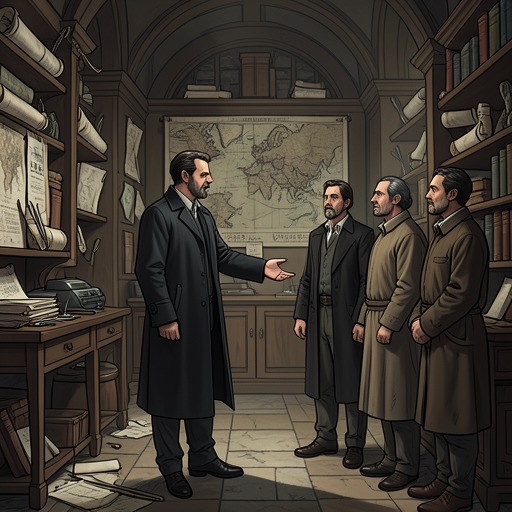
The forged letter luring Buckingham to Paris
The Three MusketeersThe forged letter luring Buckingham to Paris is the unseen instrument that converts a secret attachment into an international emergency. Presented as a message from Anne of Austria, it brings the Duke of Buckingham into Paris under false pretenses, where the discovery of the deception does not end the danger but intensifies it: Buckingham refuses to leave without seeing the queen, Anne of Austria is placed at political and personal risk, and d'Artagnan is drawn into the mission that carries the consequences across the Channel.
Origin and Deception
The letter’s existence is first preserved through recollection rather than direct presentation. d'Artagnan has repeatedly told his companions about his encounter with the stranger at Meung and about the beautiful foreign woman to whom that man had entrusted an important message. Athos believes that d'Artagnan lost the letter during the skirmish, while Porthos interprets the episode as an interrupted love meeting. Their differing explanations establish the letter as a fragment of a larger intrigue whose meaning is initially obscured.
The central revelation comes when Athos asks whether the mercer told d'Artagnan that the queen believed Buckingham had been brought to Paris by a forged letter. The answer is that Anne of Austria fears this is so. The deception therefore impersonates the queen’s voice and exploits Buckingham’s devotion to her, making the letter both a political snare and a weapon aimed at an intimate relationship.
Buckingham’s Entrapment in Paris
Buckingham learns that the message on which he relied was a trap, but he does not simply retreat to England. Instead, his appetite for adventure and romance leads him to declare that he will not depart without seeing Anne of Austria. His insistence transforms the forgery from a completed deception into an active crisis: the false invitation has failed to control its victim, because Buckingham’s response is bolder and less predictable than the plotters expected.
Anne of Austria initially refuses to see him, then becomes afraid that his frustration may drive him to some reckless act. She decides that she must meet him and urge his immediate departure. The plan depends on Madame Bonacieux, who has been charged with fetching Buckingham and conducting him to the Louvre, but Madame Bonacieux is abducted and disappears for two days. Once she is free and able to communicate with Monsieur Laporte, the suspended plan resumes, three days later than intended.
Madame Bonacieux eventually guides Buckingham through a servants’ entrance and the concealed passages of the Louvre. She leads him up and down several flights and corridors, unlocks an apartment, and tells him, “Remain here, my Lord Duke; someone will come.” She then locks the door, leaving him literally a prisoner before the meeting can occur. The forged letter thus produces a chain of confinement and clandestine movement involving Buckingham, Madame Bonacieux, Anne of Austria, and the Louvre household.
From False Invitation to Royal Gift
Buckingham does not react to his isolation with fear. The danger confirms the romantic and adventurous character that brought him to Paris in the first place. When Anne of Austria finally appears, the encounter turns the fraudulent summons into a genuine exchange between the two lovers. She returns almost immediately with a rosewood casket bearing her cipher in gold and gives it to Buckingham as a remembrance. The casket becomes the tangible remainder of their meeting and a private counter-sign to the letter’s counterfeit message.
The political danger, however, remains. Buckingham’s presence in Paris is tied to the queen’s reputation and to Cardinal Richelieu’s efforts to expose or exploit her connection with him. The forged letter has therefore created a situation in which a private token can carry public consequences: the rosewood casket expresses affection, while the circumstances surrounding it can be interpreted as evidence of treasonous or compromising intimacy.
The Cross-Channel Consequences
The deception directly generates the mission that sends d'Artagnan and Planchet to England. After reaching Dover at half past ten in the morning, d'Artagnan travels onward to London, unable to speak English but able to find Buckingham’s hotel by showing his name on a piece of paper. The speed and difficulty of this journey show how an apparently small written object reorganizes movement across national borders.
Buckingham gives d'Artagnan a chamber adjoining his own because he wants the young man close at hand, chiefly so that he can speak continually about Anne of Austria. At the same time, England publishes an ordinance forbidding every vessel bound for France to leave port, including the packet boat carrying letters. To everyone, this appears to be a declaration of war between England and France. The forged summons has consequently helped connect romantic secrecy with military mobilization and the interruption of ordinary communications.
The mission’s immediate purpose is to recover the queen’s diamond studs. Buckingham has two studs remaining and orders exact imitations to be made; within two days, the copies are so perfect that neither he nor experts can distinguish them from the originals. He gives the newly made studs to d'Artagnan, but keeps the rosewood casket, explaining that it is more precious because it is all that remains to him. The forged letter therefore leads indirectly to an exchange in which counterfeit jewels preserve the queen’s public appearance while the casket preserves Buckingham’s private memory.
When d'Artagnan returns to France, M. de Treville recognizes the jewel as a genuine royal object. D'Artagnan insists that it did not come from an enemy but from the queen herself, and says that Anne of Austria gave it to him personally. This distinction between enemy gift and royal gift echoes the original deception: the story repeatedly makes objects and messages bear meanings that depend on who appears to have sent them.
Wider Political Meaning
The forged letter’s effects extend beyond the lovers and their agents. Cardinal Richelieu’s siege of La Rochelle is directed against the last major stronghold of French Calvinism and against the port that remains open to the English. International forces gather under the Protestant standard, including Spaniards, Englishmen, Italian malcontents, adventurers, and soldiers of fortune. The private fraud that brings Buckingham to Paris thus belongs to the same transnational world as the public conflict involving France, England, Spain, the German Empire, and Lorraine.
After Buckingham is forced to abandon his lodging, papers found there confirm a league directed against France and compromise Madame de Chevreuse and, consequently, Anne of Austria. The political apparatus treats personal correspondence and private papers as instruments of state power. A letter that began by imitating the queen’s voice ultimately feeds the cardinal’s surveillance of alliances, loyalties, and suspected treason.
The object also belongs to a recurring economy of written authorization and deceptive authority. Later, when Cardinal Richelieu confronts d'Artagnan, he takes back one carte blanche and offers another: a commission with the name left blank, which d'Artagnan discovers is a lieutenant’s commission in the Musketeers. This later document contrasts with the forged letter. Both derive power from writing, but one conceals its true author while the other openly places authority in the recipient’s hands. Together they show how, in the novel’s political world, paper can imprison, mobilize, accuse, reward, or transform a man’s rank.
The forged letter luring Buckingham to Paris is therefore more than a plot device. It is the first false message in a chain of consequences that includes clandestine entry into the Louvre, Madame Bonacieux’s abduction, the queen’s rosewood casket, the diamond-stud mission, the interruption of Anglo-French communications, and the exposure of an international league. Its decisive irony is that deception fails to produce simple obedience: instead, it releases romance, violence, travel, surveillance, and war.